Alex
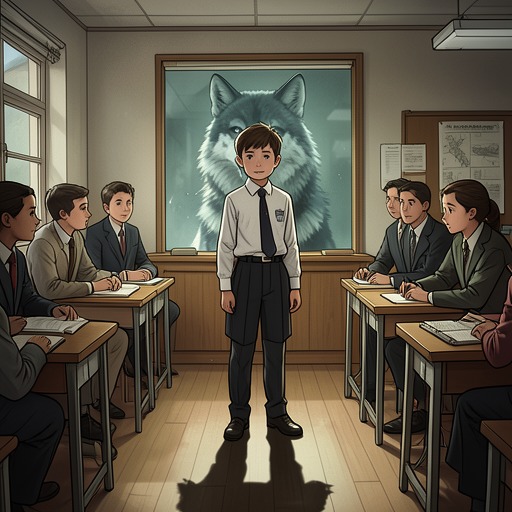
I'm the Werewolf in my ClassAlex is Sebastian Wolfe’s best friend and one of the first people to recognize that his familiar behavior has begun to change. Her importance lies less in supernatural power than in her insistence on ordinary friendship: she notices, questions, follows, teases, and ultimately stays. As Sebastian moves from unexplained bodily terror to werewolf identity, Alex becomes a test of whether the secret will isolate him or be absorbed into the relationships that already define his life.
Identity and Introduction
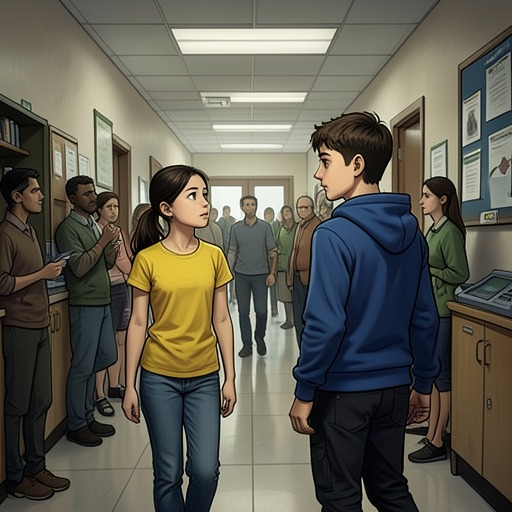
Alex enters the story on the walk to school, falling into step beside Sebastian after he leaves home abruptly, distracted by what his parents are withholding. She has been calling his name for nearly a block before punching his arm to reclaim his attention. The gesture establishes their ease with one another, while her immediate awareness of his distraction shows that she knows his ordinary manner well enough to detect a disturbance beneath his brief apology.
That familiarity later becomes a form of pressure. When Sebastian hides in a bathroom stall after suffering nausea, blurred vision, and the first visible signs of transformation, Alex comes to check on him because Mr. Hoffman sent her. She asks whether he is all right, then directly challenges his explanation after he attributes his condition to a stomach ache. Her knowledge of him makes concealment difficult: the supernatural secret is new, but the friendship surrounding it is longstanding.
Perception and the Problem of Secrecy
Alex repeatedly functions as the person who refuses Sebastian’s evasions. At lunch, she corners him and demands an explanation, reminding him that she has known him since kindergarten and can tell when he is hiding something. Her scrutiny becomes especially dangerous to Sebastian because his life is divided between school, family secrecy, and the newly discovered werewolf world. He wants to deflect her questions, yet the arrival of Mia interrupts the moment before he can decide how much to reveal.
The contrast between Alex’s perception and Sebastian’s excuses defines the early friendship dynamic. When he experiences heightened senses and an uncontrolled transformation, he offers ordinary explanations such as low blood sugar, birthday jitters, or something he ate. Alex does not possess the information needed to name the truth, but she correctly registers that these explanations do not account for his behavior. Her concern therefore precedes knowledge; she responds first to the visible strain in her friend and only later to the supernatural cause.
Adaptation to the Werewolf World
Alex’s relationship with Sebastian crosses into the hidden werewolf conflict before she fully understands it. During the crisis at Crescent Hill High, Lily warns Sebastian that the rogues have entered the school and may have discovered his connection to the artifact. Alex is part of the ordinary school environment Sebastian is trying to protect, making her presence a reminder that his supernatural danger has invaded the human sphere.
The story also places Alex beside the pack’s secrecy through the comic Halloween disguise. Ethan and Lily push Sebastian toward a bathroom with an intentionally exaggerated werewolf costume before first period. Alex and Mia laugh when he emerges in it, treating the disguise as a joke rather than recognizing how closely it resembles the identity he is struggling to conceal. The scene turns hidden stigma into visible performance: Sebastian can appear as a werewolf in public because the costume makes the truth legible as fiction.
Revelation and Response
After the clock-tower battle, Sebastian awakens to learn that Mia knows the truth and that the artifact is safe. Ethan and Lily then enter with Alex, whose reaction combines reproach and relief. She lightly punches Sebastian for keeping secrets, then hugs him for surviving the plunge from the tower. The paired gestures express the terms of her acceptance: she does not erase the betrayal involved in being excluded, but neither does anger outweigh her gratitude that he is alive.
Sebastian apologizes, explaining that he wanted to tell both Alex and Mia but did not know how. Alex answers with a joke about the wolf being out of the den. Her humor does not deny the seriousness of the disclosure; it gives the group a shared language in which the frightening secret can be acknowledged without making Sebastian untouchable. The revelation changes the friendship from one based on incomplete information into one capable of holding the whole of his experience.
Change and Narrative Significance
Alex’s most consequential change is not a transformation of her body but a rapid revision of what counts as normal. After learning about werewolves, she and Mia ask questions, make jokes, and adapt to the new reality as though it were something they can investigate together. Alex’s response converts supernatural identity from a source of anticipated rejection into a condition the friendship can accommodate.
Her final exchanges with Sebastian combine affection, comic insult, and loyalty. She calls him a furry freak with a smirk, while he laughs and admits that he does not know what he would do without his friends. The scene presents Alex as an anchor of continuity: Sebastian’s powers, the artifact’s bond, and his uncertain status as something beyond an ordinary werewolf all threaten to redefine him, but Alex continues to address the same friend she has known since childhood. Through her, the narrative links secrecy, stigma, and belonging, showing that disclosure does not end identity conflict but can prevent it from becoming isolation.